Stop Targeting the Wrong Clients: Two Critical Mistakes AI Agency Owners Make
Most new AI agency owners fail because they chase the wrong clients before proving one clear offer in one reachable market.

AI Agency Strategy
Stop Targeting the Wrong Clients: Two Critical Mistakes AI Agency Owners Make
Bottom Line Up Front
Most new AI agency owners fail because they chase the wrong clients, not because their service is bad. Two mistakes stand out: targeting wealthy markets without local traction first, and selling to industries that are either already disrupted by AI or structurally unprofitable. The fix is simpler than you think—pick industries where the same use case generates real revenue, then go local before you go global.
Mistake 1: Chasing American Clients Before Local Traction
The logic sounds perfect on paper. American businesses have money. They're easier to convince. Currency arbitrage makes your fees go further. A young agency owner in Italy laid out exactly this case—and it makes sense theoretically. But theory breaks down fast when you're cold-calling or emailing strangers online.
The friction of reaching decision-makers remotely is brutal when you have no track record. You're fighting against email filters, gatekeepers, and the simple fact that busy business owners don't answer unknown numbers. Online outreach works best when you already have proof of concept.
The practical move: start local. Go to your city. Find established business owners at BNI chapters, Rotary clubs, Lions Clubs, local chambers of commerce, or industry association meetings. These are places where decision-makers actually show up and talk to people. You get face time. You build trust faster. You close your first clients. Then, with case studies and testimonials, you can expand geographically—including to the US market if you want.
Mistake 2: Selling to AI-Disrupted or Unprofitable Industries
Marketing agencies are already adopting AI aggressively. They need you the least. They're not your ideal customer—they're your competition.
Real estate brokers, barbers, electricians, plumbers, restaurants—these all feel like good ideas until you actually try to sell to them. Real estate is a huge market, but brokers specifically operate on thin margins and move slowly on new tools. Barbers (especially male-focused shops) don't have the budget. Electricians and plumbers are skeptical of tech and price-sensitive. Restaurants are notoriously difficult—low margins, high turnover, owners stretched thin.
The pattern: these industries either lack the budget, are already disrupted, or have structural reasons to resist what you're selling. You can use the same AI solution in a different industry and make 3-5x more money with half the sales friction.
Questions from this section
Why is going local better than targeting wealthy markets online?
Remote cold outreach has massive friction when you have no proof of concept. Local, in-person networking gives you face time, builds trust faster, and lets you close your first clients before you try to scale geographically. Once you have case studies and testimonials, expanding online becomes much easier.
Why shouldn't I target marketing agencies?
Marketing agencies are already adopting AI aggressively. They're not behind the curve—they're ahead of it. They need you the least and are more likely to be your competition than your customer.
What's wrong with targeting restaurants or barbers?
Both have structural issues. Restaurants operate on thin margins with stretched-thin owners. Barbers (especially male-focused shops) have low revenue per location. You can solve the same problem in a different industry and make significantly more money with less sales friction.
Where to Find Your First Clients
Skip startup hubs and networking events aimed at young founders. Those rooms are full of people with ideas and no money. Instead, target events where established business owners gather.
Look for BNI chapters (Business Network International—they meet weekly and are designed for referral partnerships). Rotary clubs and Lions Clubs. Local chambers of commerce. Industry-specific associations and their local chapters. A roofing association. An accounting association. A real estate association. These groups have recurring meetings, established members with decision-making authority, and a culture of doing business together.
Show up. Talk to people. Listen to their problems. Offer to help with a specific use case. Close your first deal. Repeat.
Industries to Avoid (And Why)
Marketing agencies: Already adopting AI. They're ahead of you, not behind you.
Real estate brokers: Thin margins, slow adoption, not the real opportunity in real estate.
Barbers (male-focused): Low revenue per shop. Budget doesn't justify your fees.
Local electricians and plumbers: Skeptical of tech. Price-sensitive. Hard to reach decision-makers.
Restaurants: Honorable industry, but structurally difficult. Owners are stretched thin. Margins are thin. Turnover is high. You're making your job harder for no reason.
The common thread: either they lack budget, they're already disrupted, or they have structural reasons to resist. Don't fight these headwinds when easier markets exist.
The Right Way to Pick Your Market
Pick an industry where your use case generates real revenue. Then go deep in that market before you expand.
This means: find a specific problem you can solve with AI. Identify which industries have that problem AND the budget to pay for the solution. Start local. Get your first three to five clients. Build case studies. Then expand geographically or add adjacent industries.
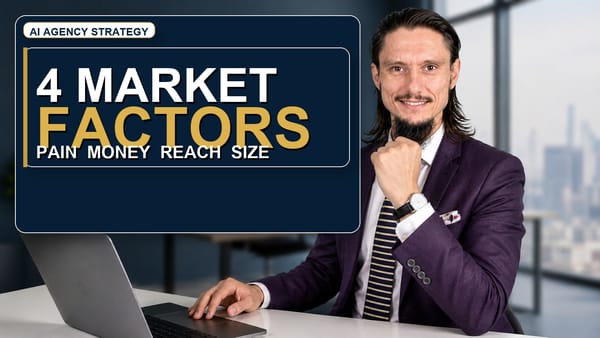
| Market signal | Good sign | Warning sign |
|---|---|---|
| Budget | The buyer can connect the use case to revenue, saved labor, faster follow-up, or risk reduction. | The buyer likes the idea but cannot justify even a small paid pilot. |
| Access | You can meet decision-makers locally, through events, associations, referrals, or warm communities. | Your only path is cold outreach to strangers in a market where you have no proof yet. |
| Urgency | The problem is already costing money, leads, time, or operational capacity. | The problem is interesting but not painful enough to create action this quarter. |
| AI readiness | The market understands the pain but still needs help turning AI into a working process. | The market is either already saturated with AI vendors or too skeptical to engage. |
The mistake most new agency owners make is trying to optimize for everything at once—best geography, best industry, best pricing, best positioning. Pick one thing. Own it. Prove it works. Then expand. Your first market doesn't have to be your biggest market. It just has to be your first win.
Frequently Asked Questions
How do you know which niche to target?
Start by identifying a specific problem you can solve with AI, then find industries that have that problem AND the budget to pay for it. Don't optimize for everything at once—geography, industry, pricing, positioning. Pick one thing and own it. The best niche isn't the biggest market; it's the one where your use case directly connects to revenue, saved labor, faster follow-up, or risk reduction. Your first clients should be able to justify even a small pilot. That's your signal you've picked right.
How are you actually winning new clients right now?
Stop chasing remote leads and go local. Show up at BNI chapters, Rotary clubs, Lions Clubs, local chambers of commerce, and industry association meetings where established business owners actually gather. You get face time, build trust faster, and close your first clients before you try to scale. Once you have case studies and testimonials from real local work, expanding geographically—including to wealthier markets online—becomes much easier. The friction of cold outreach disappears when you have proof of concept.
Why shouldn't I target marketing agencies?
Marketing agencies are already adopting AI aggressively. They're not behind the curve—they're ahead of it. They need you the least and are more likely to be your competition than your customer. You're fighting an uphill battle when easier markets exist. Pick an industry where you're solving a problem they haven't solved yet, not one where they're already ahead of you.
What's wrong with targeting restaurants or barbers?
Both have structural issues that make them hard sells. Restaurants operate on thin margins with stretched-thin owners and high turnover. Barbers, especially male-focused shops, have low revenue per location and can't justify your fees. You can solve the exact same problem in a different industry and make 3-5x more money with half the sales friction. Don't fight these headwinds when easier markets exist.
How narrow or broad should your niche be?
Narrow enough that you can own it and build real case studies. You're not trying to serve "all small businesses"—that's too broad and kills your credibility. Pick a specific industry, solve a specific problem, get your first three to five clients locally, then expand. Broad positioning comes later, after you've proven the model works in one tight market.
Should you start with only one product or build a massive store overnight?
Start with one use case in one industry. Get it right. Close your first clients. Build case studies. Then expand to adjacent industries or add new use cases. The mistake most new agency owners make is trying to optimize for everything at once. Your first market doesn't have to be your biggest market—it just has to be your first win. Prove the model works before you scale.
Should every YouTube video become a blog post?
No. Long-form videos with a clear decision, tutorial, opinion, or framework deserve posts. Shorts are usually better as idea seeds unless they answer one valuable question cleanly.
Should the blog post copy the transcript?
No. The transcript is raw material. The post should be structured around the reader's question, then use the transcript as proof and source material.
Where do Reddit questions fit in?
They belong near the bottom as market-intel FAQs. The question wording can come from Reddit, but the answer should come from Florian's point of view and the article thesis.
How should I apply this if I run an AI agency?
Treat the post as a decision note about Stop Targeting the Wrong Clients: Two Critical Mistakes AI Agency Owners Make. Pull out the buyer problem, the offer implication, and the next action you can test this week.
What is the first practical step after reading this?
Write down the one workflow, outreach move, or client-facing explanation this article changes. Then test that one thing before turning it into a larger system.
How do I know whether this advice applies to my niche?
Check whether your buyers have the same underlying constraint. The tool names can change, but the useful pattern is usually the bottleneck, the buyer question, and the proof needed to move forward.
What should I avoid copying blindly?
Do not copy the surface tactic without the context. Copy the reasoning: why the move works, who it is for, and what evidence would make it credible to your buyer.
How does this help with AEO or AI search?
It turns the video into structured, answer-first HTML with visible FAQs. That gives search engines and AI systems clearer passages to cite than an unstructured transcript alone.
Should I publish this as one article or split it into multiple posts?
If the article answers one search intent, keep it together. If the transcript contains several unrelated buyer questions, split them into separate posts so each URL has a clear purpose.
Join the Community
Meet me inside AI Automations by Jack, where operators are building practical AI workflows, sharing wins, and turning ideas into implementation.
Sources and references
- Embedded YouTube video: https://www.youtube.com/watch?v=6XTqXLNtD0E
- Article adapted from Florian Rolke's video: Two Frequent Mistakes New AI Agency Owners Make.
- Reddit market-language research from public agency, AI agency, and niche-selection discussions; selected question wording is preserved where useful, and all answers are original.