Forget Cold Email: Go Where Business Owners Meet
Instead of relying only on cold email, new AI agency owners should find the physical and community spaces where business owners already gather.
AI Agency Strategy
Find Business Owners at Local Conferences: A Step-by-Step Process Using AI and APIs
Bottom Line Up Front
Forget cold email lists. The business owners you want to reach are already gathering at local conferences. You can identify these events using AI research tools, extract attendee and vendor data through Claude and API scrapers, and build a warm prospect list before you ever walk in the door. This workflow turns conferences from networking events into systematic lead-generation machines.
Why conferences beat cold email
Cold email works, but it's noisy. Conferences are different. Business owners, decision-makers, and vendors show up because they want to be there. They're already in a mindset to talk, network, and explore solutions. You're not interrupting their inbox—you're meeting them where they've chosen to spend their time and money.
The real advantage: you can research who's attending before you go. You can identify the exact people you want to meet, find their LinkedIn profiles, and start a conversation that feels natural instead of transactional. You're no longer a stranger; you're someone who knows the event, knows their industry, and shows up prepared.
Step 1: Research conferences with Perplexity
Start by defining your ideal customer profile and the geography you're targeting. Then ask Perplexity to find upcoming conferences and industry gatherings in that area.
Example prompt: "What conferences and industry events are coming up in [city] for [your target audience]? Include medical conferences, professional associations, and networking events." Give Perplexity enough context about your ICP—whether that's surgeons, dentists, tech founders, or e-commerce owners—so it can narrow the results.
Perplexity will return a list of events, dates, and organizers. You'll also get associated organizations and networking groups. This is your starting point. If Perplexity's research feels incomplete, move the results into Claude for deeper analysis and profile extraction.
Questions from this section
Do I need to pay for Perplexity and Claude to do this?
No. Both tools have free tiers that work well for this workflow. Perplexity's free plan does research and profile lookups. Claude's free tier can extract and format data from your lists. You only need to pay if you want faster processing or higher usage limits. The API tools (Tavily, Exa, Apify) have free tiers too, though you may hit rate limits if you're processing large lists.
How accurate is the data I get from these tools?
It's reliable but not perfect. LinkedIn URLs and company information are usually accurate because they're pulled from public profiles. Event attendee lists vary—some events publish full attendee rosters, others don't. Always verify key prospects manually before outreach. Check their LinkedIn profile directly, look at recent posts, and confirm they're still relevant to your ICP.
Can I use this for conferences outside my local area?
Absolutely. The workflow works for any geography. Just specify the city, region, or country in your Perplexity prompt. You can build prospect lists for conferences anywhere, then decide whether to attend in person or reach out remotely.
What if the event doesn't publish an attendee list?
Use the API scrapers (Apify, Exa, Tavily) to find people who've posted about the event on social media, pull vendor and speaker lists from the event website, or search for people who follow the event's social pages. You'll get a smaller list, but it's still valuable—these are the most engaged prospects.
Step 2: Extract profiles and data with Claude
Once you have a list of conferences and organizations, paste that into Claude and ask it to find and format LinkedIn profiles, Facebook pages, and other social profiles for attendees, vendors, and organizers.
Prompt example: "Here's a list of conferences and organizations. For each one, find and provide clickable LinkedIn profile links for the organizers, speakers, and likely attendees. Format as a CSV with name, title, company, LinkedIn URL, and event." Claude will research and compile these profiles even on the free tier. It looks across LinkedIn, Facebook, company websites, and event pages to build a structured list.
Export the results as a CSV. This becomes your raw prospect data.
Step 3: Automate data collection with APIs
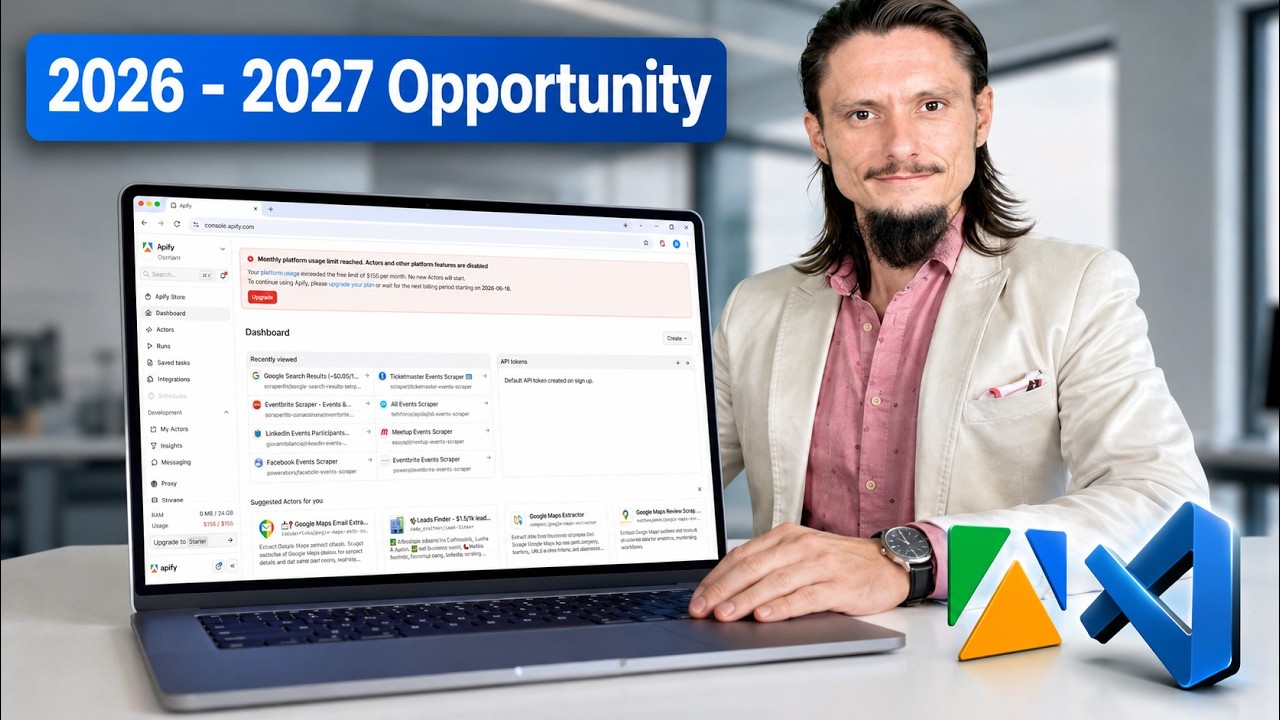
For scale and real-time data, set up API keys from Tavily, Exa, and Apify. These tools let you programmatically query event data, scrape attendee lists, and pull social profiles without manual work.
Store your API keys in a .env file and use a script runner like VS Code to execute queries. For example, you can query Tavily to find current events at a specific location, use Exa to search for people who've posted about the event on social media, and use Apify's Facebook and LinkedIn event scrapers to extract attendee and vendor data.
The workflow: query the API → parse the response → format into a list → deduplicate and clean → export to your CRM. Rinse and repeat for each event or geography.
Building your prospect list
Your final list should include:
- Event name and date - Attendee/vendor/organizer name and title - Company and industry - LinkedIn profile URL - Social media profiles (if available) - How they're connected to the event (attendee, vendor, speaker, organizer)
Clean the data: remove duplicates, verify URLs, and segment by relevance to your ICP. You now have a warm list of people who will be in the same room at a specific time and place.
This list is gold for outreach. You can reach out before the event ("I'll be at [event] on [date]—would love to grab coffee"), during the event ("Just saw your talk on [topic]"), or after ("Great to meet you at [event]—following up on our conversation").
Execution and follow-up
Attend the conference with your list in hand. Your goal isn't to work the room randomly—it's to have intentional conversations with people you've already researched and qualified.
Before you go: reach out to 5–10 top prospects and suggest a coffee or lunch during the event. During the event: look for people on your list, reference something specific about their work or company, and have a real conversation. After the event: follow up with everyone you met, reference the specific conversation, and move them into your sales process.
This turns a conference from a networking expense into a predictable lead-generation channel.
Frequently Asked Questions
Do I need to pay for Perplexity and Claude to do this?
No. Both tools have free tiers that work well for this workflow. Perplexity's free plan does research and profile lookups. Claude's free tier can extract and format data from your lists. You only need to pay if you want faster processing or higher usage limits. The API tools (Tavily, Exa, Apify) have free tiers too, though you may hit rate limits if you're processing large lists. Start free, upgrade only when you're running this at scale.
How accurate is the data I get from these tools?
It's reliable but not perfect. LinkedIn URLs and company information are usually accurate because they're pulled from public profiles. Event attendee lists vary—some events publish full attendee rosters, others don't. Always verify key prospects manually before outreach. Check their LinkedIn profile directly, look at recent posts, and confirm they're still relevant to your ICP. Think of the data as a starting point, not gospel. Your manual verification is what turns a lead list into a qualified prospect list.
Can I use this for conferences outside my local area?
Absolutely. The workflow works for any geography. Just specify the city, region, or country in your Perplexity prompt. You can build prospect lists for conferences anywhere, then decide whether to attend in person or reach out remotely. The real advantage of this system is that you're not limited by geography—you can research events globally and prioritize based on where your ICP clusters or where you want to expand.
What if the event doesn't publish an attendee list?
Use the API scrapers (Apify, Exa, Tavily) to find people who've posted about the event on social media, pull vendor and speaker lists from the event website, or search for people who follow the event's social pages. You'll get a smaller list, but it's still valuable—these are the most engaged prospects. Engaged attendees who post about events or follow them online are often higher-quality leads anyway because they're actively participating, not just passively attending.
What should my final prospect list include?
Your final list should include: event name and date, attendee/vendor/organizer name and title, company and industry, LinkedIn profile URL, social media profiles (if available), and how they're connected to the event (attendee, vendor, speaker, organizer). Clean the data by removing duplicates, verifying URLs, and segmenting by relevance to your ICP. This structured list is what turns a conference from a networking expense into a predictable lead-generation machine.
How should I follow up after meeting someone at a conference?
Follow up with everyone you met, reference the specific conversation you had, and move them into your sales process. The key is specificity—mention something they said, a problem they mentioned, or a connection you made. This isn't a generic "nice to meet you" email. You've already done the research, had a real conversation, and now you're continuing a relationship that started in person. That's what makes this different from cold email.
Should every YouTube video become a blog post?
No. Long-form videos with a clear decision, tutorial, opinion, or framework deserve posts. Shorts are usually better as idea seeds unless they answer one valuable question cleanly.
Should the blog post copy the transcript?
No. The transcript is raw material. The post should be structured around the reader's question, then use the transcript as proof and source material.
Where do Reddit questions fit in?
They belong near the bottom as market-intel FAQs. The question wording can come from Reddit, but the answer should come from Florian's point of view and the article thesis.
How should I apply this if I run an AI agency?
Treat the post as a decision note about Find Business Owners at Local Conferences: A Step-by-Step Process Using AI and APIs. Pull out the buyer problem, the offer implication, and the next action you can test this week.
What is the first practical step after reading this?
Write down the one workflow, outreach move, or client-facing explanation this article changes. Then test that one thing before turning it into a larger system.
How do I know whether this advice applies to my niche?
Check whether your buyers have the same underlying constraint. The tool names can change, but the useful pattern is usually the bottleneck, the buyer question, and the proof needed to move forward.
What should I avoid copying blindly?
Do not copy the surface tactic without the context. Copy the reasoning: why the move works, who it is for, and what evidence would make it credible to your buyer.
How does this help with AEO or AI search?
It turns the video into structured, answer-first HTML with visible FAQs. That gives search engines and AI systems clearer passages to cite than an unstructured transcript alone.
Should I publish this as one article or split it into multiple posts?
If the article answers one search intent, keep it together. If the transcript contains several unrelated buyer questions, split them into separate posts so each URL has a clear purpose.
Join the Community
Meet me inside AI Automations by Jack, where operators are building practical AI workflows, sharing wins, and turning ideas into implementation.
Sources and references
- Forget Cold Email: Go Where Business Owners Meet
- Embedded YouTube video: https://www.youtube.com/watch?v=dy6dfbcUhVQ